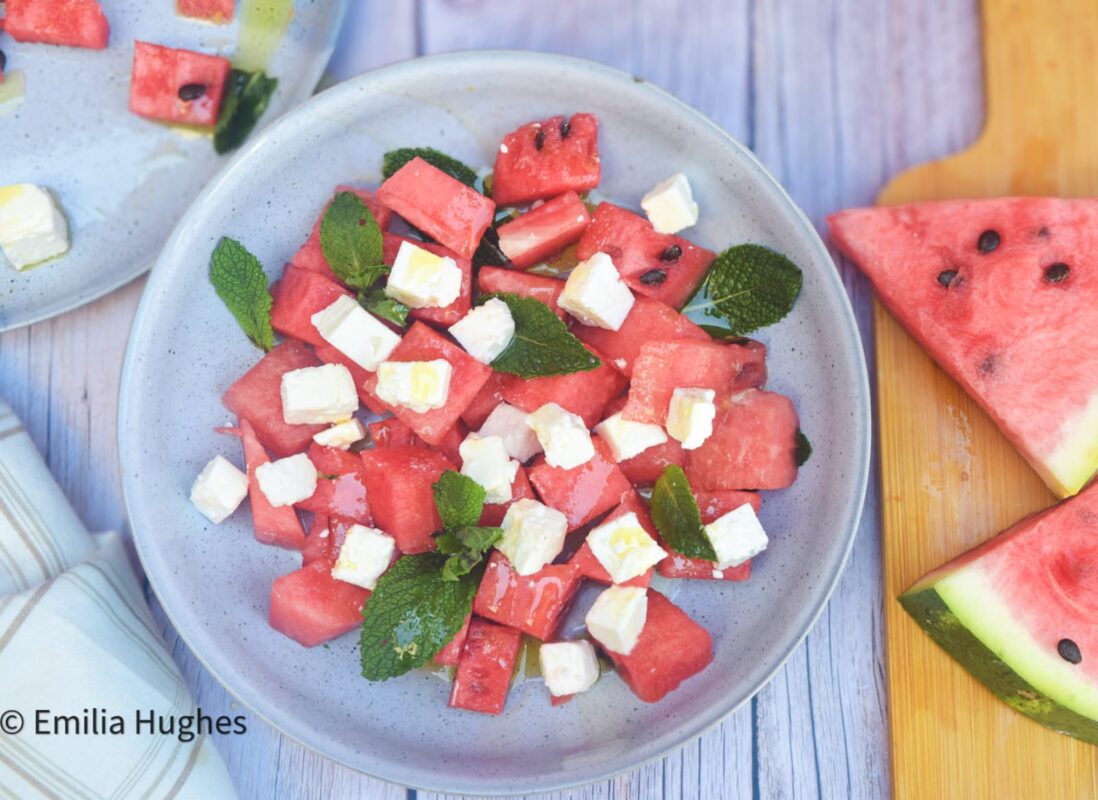
Juicy Watermelon and Feta Salad
I’m a big believer in eating fruit in season
Watermelon season is here, so it appears on our table almost every day.
Watermelon is made up of more than 90% water, so eating it on its own won’t keep you full for long. It’s a bit like drinking a glass of juice – you’re mainly getting carbohydrates, while it’s lacking the protein and fat that help keep you satisfied and maintain steadier energy levels. That’s why I like to pair it with a good source of protein and a little healthy fat.
One of the best examples is this watermelon, feta and mint salad. Although it’s most commonly associated with Greece, similar combinations have been enjoyed for many years throughout the Mediterranean region.
Not all feta is the same
This is especially important if you don’t tolerate cow’s milk well.
Authentic traditional feta is made from:
- at least 70% sheep’s milk,
- with up to 30% goat’s milk.
Traditional Greek feta cannot be made from cow’s milk. In the European Union, the name “Feta” is protected by a Protected Designation of Origin (PDO), meaning it must be produced in specific regions of Greece using the traditional recipe.
If the label says “salad cheese”, “Greek-style cheese”, or “feta-style cheese”, it’s most likely not authentic feta but a cheese made from cow’s milk.
Sheep’s and goat’s milk feta is available in supermarkets such as Lidl and Aldi. However, it’s always worth turning the package over and checking the ingredient list, as recipes vary between manufacturers and the ingredients tell you far more than the name on the front.
It’s worth remembering that if you don’t have a cow’s milk allergy or intolerance, choosing traditional feta isn’t essential from a health perspective. However, if you avoid cow’s milk or simply prefer traditional products, authentic sheep’s and goat’s milk feta is an excellent choice.
Why I always add olive oil
Although olive oil isn’t always included in the traditional version of this salad, I always add it for two reasons.
First, a small amount of good-quality extra virgin olive oil hardly changes the flavour of the salad. Second, it enriches the dish with heart-healthy monounsaturated fats (primarily oleic acid, an omega-9 fatty acid), an important part of a balanced diet that supports both heart and brain health.
Adding a little extra fat also makes the salad much more satisfying, helping you stay full for longer than if you ate watermelon on its own or prepared the salad without the olive oil.
Juicy Watermelon and Feta Salad
Ingredients
- 200 g watermelon cut into cubes
- 50 g feta cheese
- 6 –8 fresh mint leaves
- 1 teaspoon extra virgin olive oil optional
Instructions
- Cut the watermelon into cubes and place them in a serving bowl.
- Cut the feta into larger chunks and add it to the watermelon.
- Finely chop or tear the mint leaves and add them to the salad.
- Drizzle with extra virgin olive oil and serve immediately.


You May Also Like

Fresh and crunchy Waldorf salad
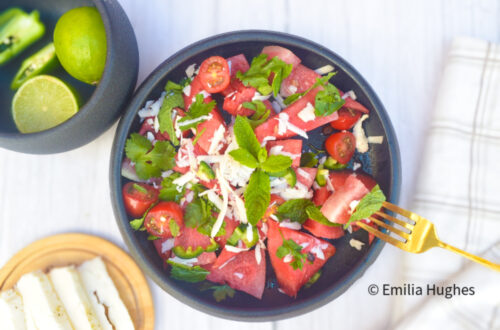
Thai – Style Watermelon & Halloumi Salad